Sunday, 26 May 2024

MY NEW BOOK REVIEW . . . NONE OF THIS IS TRUE by LISA JEWELL


I don't normally spend great chunks of time reading a novel during the day; I'm a woman . . . I'm busy. But I could hardly put this psychological crime thriller down because I was hooked right from the word go. It's written with the lightest of touches, almost as if it's chick-lit . . . but it's most certainly not chick-lit.

It all kicks off on Saturday 8th June 2019 in a trendy London gastropub where two women are celebrating their forty-fifth birthdays with their families. 

The more attractive, popular and successful woman - Alix Summers (and of course why wouldn't she be given her upbeat name) -  is with her husband, two children, three sisters and their husbands, plus close friends, and they're having a ball. Champagne, presents, balloons, lots of excited chatter, other diners are drawn to this noisy, happy group, and why wouldn't they be. I've seen plenty of similar party groups and it's very easy to assume that people like this have exceedingly happy and exciting lives. 

Alix in particular seems to have it all: stunning good looks, tanned, tall, slim, trendy ice-blonde hair, fabulous clothes and jewellery, doting husband, nice kids and supportive sisters. The stuff of chick-lit but, as I said, this is not chick-lit. Is she as nice as she appears to be, though, and is her family as perfect as it seems to be?

Our second birthday girl is Josie Fair, who has more of a quiet attraction or so Alix thinks. She's particularly taken with Josie's long wavy auburn hair and brown eyes which are almost black. Josie is with her husband, Walter, who's so much older than her that he looks more like her father than husband, wearing new clothes still creased out of their wrappings. Eating out is not what they usually do and it shows. 

We learn very little about Walter to begin with, although more about Alix's husband, Nathan, who's an estate agent dealing with top-end properties. Although he earns a lot of money, physically he doesn't appear to be the kind of man that a stylish, beautiful woman like Alix would be attracted to:  his unruly shock of bright red hair, undescript face and white, shapeless legs rather like school boy, are hardly flattering attributes. 

There's just one birthday present for Josie and a simple meal compared with the many plates of food which keep arriving at Alix's table, plus very little in the way of conversation So right from the beginning, the two birthday parties and the two birthday girls couldn't be more different.

Josie is so immediately fascinated by Alix Summers that she Googles her name on her mobile while she's sitting at her table (she knows her name because the waitress called it out) and learns that Alix is a successful podcaster whose subjects are highly successful women. So as soon as Alix retreats to the cloakroom, Josie follows her, announces that they are birthday twins and invites Alix to the clothes alteration business where she works because she has an interesting proposition for her.

Intrigued by this, Alix does visit Josie. She's looking for a way to expand her podcast business and when Josie tells her that she wants to totally change her life and for Alix to document this, Alix takes the bait. Particularly when Josie hints at dark secrets she wishes to reveal.

'Don't do it, Alix !!!' many readers will already be shouting at the pages of the novel. Because Josie Fair is a seriously spooky person who quite clearly has a will of iron. From her eccentric denim wardrobe to the aggressive Pomchi look-a-like dog she carries in a dog carrier to her relentless worming her way into Alix's life, she appears to be a person to avoid not embrace.

But Alix thinks that a podcast centred around Josie is a potential big hit and so the Hi! I'm Your Birthday Twin podcast begins to take shape. Every day Josie makes her way from her dingy council flat to Alix's fabulously stunning Edwardian house to tell her story in Alix's recording studio in her garden.

And what a story it is. Married at seventeen to Walter, who she met when she was just thirteen, with a daughter, Roxy, who ran away from home when she was sixteen, and another daughter, Erin, who stays in her untidy, smelly bedroom gaming on her computer all day. Erin has never eaten solid food and lives off baby food in jars and tubs of deserts, which Josie religiously prepares for her every day and leaves outside her room on a tray. Really? The word gross comes to mind.

We learn about Josie and her family bit by bit and not in massive detail.  In fact, Jewel's writing style of less is more threads its way throughout the novel, and Jewell forces us to speculate for ourselves rather than tell us straight off . . .  and it works. We want to learn more so we keep turning those pages, which is very clever writing.

Is Walter is a paedophile? Are the girls nightmare daughters? Is Josie a tragic victim?  One thing is for sure: this is a highly dysfunctional family.

The story unfolds through day by day by accounts of the two women and extracts of Alix's interviews, including details of lighting and props, not just with Josie but also the people she's come in contact with. It's an effective technique, adding variety to the delivery of the story, and I particularly enjoyed these chapters because it was refreshing to hear the interviewees talking so freely. 

BUT at the back of the reader's mind is the title of the novel - NONE OF THIS IS TRUE.

So what is true? And who is not telling the truth?

You'll have to read the novel to find out. I hope I've given enough background to have wetted your interest but not enough to spoil the read. And there is a lot of violence I should add - this is, after all, a crime novel- but Jewell doesn't go into too much gruesome detail. Again she lets your imagination run riot. 


So what is it about this novel that I so like?

The immediate hook for me was Alix Summers. I can't remember ever understanding and sympathising with a character so much. Firstly, although I'm an author, I'm also a journalist and blogger so I appreciate that desire to get a big story, which is what drives Alix despite all the warnings signs. Secondly, she reminded me of Mollie King, the Saturdays girl band member and Radio One D.J. in appearance, charisma, openness, happy family and life style. But that's where the similarity ends, I should add straight away. However, it meant that I had a picture in my mind of Alix which in some way helped me to understand and relate to her.

And then there's Jewell's writing style which has to be amongst the best in contemporary crime writing: fluent and seemingly effortless but packing an enormous punch to the gut as she allows the story to slowly unfold. Every detail, every description, adds to the story without being over-flowery or over-dramatic. Economical writing is a good way to describe it and believe me, that's not easy to achieve.

I previously read an earlier novel by Jewell - The Family Upstairs - which is different in structure but just as powerful. It was because I enjoyed this novel that I chose to read None Of This Is True. Jewell has also written a further nineteen novels, which means that there are more novels for me to read. 

And she's been noticed in Hollywood. In 2022 she was commissioned by Disney to write a full-length novel for Marvel. It'll be the first novel in a new series called Marvel Crime, using the existing character of Jessica Jones, a private investigator. This is a new genre for Jewell to tackle and she admits that it's been quite a challenge. Titled Breaking the Dark, it comes out in July 2024. Guess who'll be reading it.

And finally, and this is just on a personal level, Jewell is a dog lover and has just adopted a rescue dog from Romania. No surprise then that there are two dogs in None Of This Is True. I'm also a dog lover and in the process of editing my two fun fantasy novels which have dogs (and a cat) as main characters. If I can write anywhere near as well as Jewell I'll be a very happy woman.


Something really spooky happened while I was researching Lisa Jewell which I'm going to tell you about because we all need to be vigilant when using the internet. From time to time I've been getting a Facebook Friend request plus messages by someone calling themselves Robert Tammy. He claims to be an ex-military American and apparently likes what I write on Facebook and would like to get to know me better !!! These messages are interspersed with flower emojis and since I'm highly suspicious of such requests,  I've always immediately declined such offers of friendship. 

So, Lisa Jewell's Facebook site is available for all to see and I decided to write a brief message on her post about None Of This Is True saying how much I liked the novel. Imagine my horror, then, when I was notified that Robert Tammy had posted a message to me right after my message to Lisa Jewell on HER Facebook site. 

By the time I showed this to my husband, the message had disappeared but re-appeared after a comment from another woman on this post, changing my name to hers !!!  My husband photographed the message and reported it to Facebook so I'm hoping that it'll be investigated.

Robert Tammy is probably a made-up name, his smiling photograph not his, and it could even be a woman or a group of people who are looking for easy targets to con out of money at some stage, or, even worse, to arrange a meet.  And the irony is that this scenario could easily be part of a Lisa Jewell novel. So be warned . . . anyone can be the target of such despicable people.


Sunday, 7 April 2024

MY NEW BOOK REVIEW: VERA WONG'S Unsolicited Advice for Murderers . . . by Jesse Sutanto (published in 2023 by Harper Collins)


I found this novel in the book section of my local Sainsbury's, thought the cover was eye catching and the title interesting, flicked through and read a few paragraphs, liked what I was reading and bought a copy, despite having never heard of the author before. And as soon as I started reading it, I was hooked. And that hook was VERA WONG.

Vera runs a most unusual teahouse called VERA WONG'S WORLD FAMOUS TEAHOUSE in Chinatown, San Francisco, although it's far from being world famous. It's dingy, uninviting and claustrophobic, with grubby windows and just one customer: ALEX, an elderly Chinese man with a wife suffering from dementia.

What Vera doesn't know about tea isn't worth knowing. A cabinet containing one hundred and eighty-eight drawers full of high quality tea imported from China completely covers one wall, and everyone who samples her tea agree that Vera makes a mean cup of tea. But Vera's original customers have either moved away or died and she doesn't have the money to modernise the place. In fact, it runs at a loss and Vera has been covering the bills out of her savings, which have dwindled to almost nothing.

But Vera is one hell of a determined woman, with an unshakeable belief in herself and her abilities. Pig-headed, stubborn, judgemental and unable to take no for an answer are just a few of her many qualities.

Still very active at the age of sixty, she takes a brisk walk every morning and then bombards her son, TILLY, with messages e.g. complaining that he sleeps for too long and reminding him to eat. Quite clearly she's disappointed with his lack of contact with her, and she is obviously a very lonely woman.  

But that all changes one morning when she descends from her also small and dingy flat above the shop to find a dead body in the middle of her teahouse. 

That dead body is a young man called MARSHALL. The police don't suspect foul play, but Vera is convinced that he was murdered and so decides to find the murderer by herself. In her opinion, the police are way too incompetent to solve the crime themselves, and Vera is nothing if not self-opinionated. She even unashamedly hides vital evidence from the police. 

That very same day four people arrive at her teahouse, all of whom are connected to Marshall in their own, very different, ways. There's RIKI, a young man who claims to be a reporter; SANA, a nervous young woman; JULIA, Marshall's wife and mother of his young daughter; and OLIVER, Marshall's twin brother.

What becomes very clear is that Marshall was not a nice person, and each of the four visitors had every reason to murder him, but which one is the murderer? Vera befriends them all and then ruthlessly prises out the truth that each one has been desperately hiding from her. And so the story unfolds as the four interact not just with Vera but also with each other. 

Vera keeps notes recording her discoveries and speculations, and I'm going to share with you an excerpt of her notes which reveal something of the way that Vera thinks and also gives a flavour of Sutanto's writing style, which is one of the reasons why I absolutely adore this novel:-

VERA WONG'S MURDER CASE

Victim: Marshall Chen, 29

Cause of death: Unknown

Suspicious signs:

1. Bruise on left cheek (someone punch him??)

2. Scratches on right cheek (someone scratch him!?)

3. Holding a flash drive (WHAT IS INSIDE?! Maybe nuclear code? Is he spy? (KGB?)

4. His fingers swollen. Everything swollen. Like me in third trimester.

5. He has baggie full of DRUGS. You see? Must be a bad person. This is not Hollywood, why is he carrying drugs around?

So scary! EXCITING! I am helpless old lady. What to do? Is my duty to find killer before killer go on rampage. Killer will come back for flash drive. I will identify killer and catch him her them!

Vera also has another weapon in her vast array of tactics. FOOD. Copious amounts of Chinese food, of course, and absolutely mouth watering. She feeds not only her new friends but also the police, arriving at their headquarters armed with a multitude of her home made dishes to tempt the officers into divulging facts about the case. They know that they should send her packing but really, that food is just so darn good.

Of course, Vera does eventually discover the murderer and, for me, it was a big surprise but totally making sense. And all the loose ends involving her four main suspects are neatly resolved, leaving me, the reader, feeling exceedingly happy.

So what is it about Vera that I like so much, given her brutal honesty irrespective of who she's talking to? Well, it's just that . . . her brutal honesty. She says exactly what she's thinking, which is so refreshing, and something I wish I could do more but am often just too polite to do so. Vera is certainly not polite but she has a very big heart. She might annoy the hell out of everyone but she's a lot of fun to be around and there is that glorious food and those perfect cups of tea.

All the other characters are also well-rounded and likeable. So much so that I wondered how Vera would respond (and how I would respond) when she eventually does solve the case. She may be satisfied that she has been right all along but does she regret her discovery?

I've given you the bare bones of the plot and characters, with just a smidgen of spoilers included, so it's up to you, if you so wish, to buy a copy and enjoy the read, probably laughing out loud as you do so. 

My opinion of this novel? 

IT'S ONE OF THE FUNNIEST AND MOST ENJOYABLE NOVELS I'VE EVER READ.

***

Jesse Sutanto is a young (and stunningly beautiful) Chinese-Indonesian writer based in Jakarta, who has already published nine novels for adults, young adults and middle grade readers. Most of her characters are Chinese and she has an astute understanding of the clash of ideas, expectations and behaviour between the older and younger generations within Chinese families. Which makes for fascinating reading.

But here's the strange thing. Because I so loved Vera Wong's Unsolicited Advice for Murderers, I bought two more of her novels and was surprisingly unimpressed. (This is where my brutal honesty kicks in, which is a must for all writers and if it isn't then it should be.)

The first novel was Dial A For Aunties, published in 2021. It won the 2021 Comedy Women in Print Prize and has been optioned for a film by Netflix, so obviously a lot of people enjoyed reading it. But not me. I found the story ridiculous and the main characters irritating. Those aunties didn't even have names but were referred to as numbers so it became a tad confusing.

The second novel was I Haven't Done With You Yet, published in 2023. This was told mainly as narrative with way too much telling and way too little showing. I found the plot exceedingly slow and boring, and I didn't like the main characters.

So how come a writer can produce a brilliant novel like Vera Wong's Unsolicited Advice for Murderers  but doesn't sustain that brilliance in her other novels? I usually finish a novel even if I'm not particularly engaged with it but expecting it will improve, but I had to put these two aside, unfinished. Life really is too short to waste.

Perhaps Sutanto has been experimenting with styles, because the three novels I've mentioned are very different in style, or because she has published to many novels within a short time frame so quality has been sacrificed. Or perhaps I'm just too picky but I'm just telling it as I see it. But the one novel of hers that I love, I really love.

***

Maggie Knutson is a published author, reporter and blogger. Her humorous animal fantasy novel WALKIES and the sequel, THE GREAT ADVENTURE, are soon to be published. If anyone has ever read a really funny animal adventure novel, will you please pass on the title and author so I can assess the competition !!!


Monday, 2 January 2023

MY NEW BOOK REVIEW : The ISLAND of MISSING TREES by ELIF SHAFAK (2021) . . . Shortlisted for THE COSTA NOVEL AWARD


When I saw that this novel advertised in the women's writing magazine MSLEXIA was on the shortlist for the prestigious COSTA NOVEL AWARD, I reckoned that it must be a good read. And even better, the advertisement claimed that the novel was about a desperate and forbidden romance between a young Turkish Cypriot woman and a young Greek Cypriot man.

Cyprus is a country very close to my heart. I lived there in the 1970s and experienced the Greek Cypriot Coup in July 1974, and a week later the Turkish Invasion, which left me a refugee.

My home in Cyprus was just outside the very popular holiday resort of Famagusta, with its miles of golden beaches and a relaxed lifestyle. Add to that friendly people, plenty of cafes and restaurants, and a warm climate, so it was a great place to live. But now Famagusta is part of the Turkish occupied North and is mainly a ghost town, Turkey wanting to use it as a bargaining tool in talks. So I have never been able to return to my home or retrieve my possessions. Not that there would be any to retrieve because of the wide-spread looting which always accompanies war.

I'm now in the final editing stage of my own novel set in Cyprus during these times so I was keen to discover how Shafak presented The Cyprus Issue, as it is often called.

*

To fully understand The ISLAND of MISSING TREES you need to know the history of Cyprus so I'll give you a potted version:-

* Cyprus is a small, beautiful island in the Mediterranean, it's nearest neighbours being Turkey, just forty miles away. Since Cyprus has rich resources, ports which operate all year, and an enviable position for trading, it has been invaded for centuries by a great number of countries, including England in the form of Richard The Lionheart.

* Of all the countries which invaded the island, only Turkey left settlers there, so the island became populated by not only Greek Cypriots ( 80 % of the population) but also Turkish Cypriots ( 20 % of the population).

* From 1878 until 1974, Cyprus was governed by Great Britain and they established three military bases: Dhekelia, Episkopi and Akrotiri.

* There were good relations between the Greek and Turkish Cypriots for many years until the Greek Cypriots decided that they'd like independence from Britain. Some Greeks Cypriots even wanted Cyprus to become part of Greece, which they called enosis, but this was a step too far for the Turkish Cypriots, who most certainly did not want to be part of Greece.

* The Turkish Government wasn't too happy about this either because they still held onto the belief that Cyprus should be part of Turkey. Tensions broke out in violent ways, with much bloodshed, and the two communities separated from each other, most Turkish Cypriots living in enclaves guarded by Turkish soldiers as a form of protection. It's fair to say that most of the violence was directed by Greek Cypriots against Turkish Cypriots, so in a way they were sowing the seeds of their own downfall.

* In 1960, The British Government granted Cyprus its independence, as it did with many other countries also under its rule. A treaty was signed giving Cyprus full autonomy, with a written constitution and a Parliament set up to include politicians from both sides. This independence was guaranteed by the governments of Britain, Turkey and Greece. Britain, however, was allowed to keep its military bases on the island for security reasons.

* But the newly formed Parliament proved unworkable so it ceased to function and both sides set up their own governments. There were also new rumblings about enosis, fighting broke out again, and UN soldiers were called in to keep the peace.

* In July1974 there was a Greek Cypriot Coup organised by those wanting enosis, and a week later, the Turkish Army invaded the northern part of the island to prevent this from happening, and also to seize what they thought was rightfully theirs.

* Thousands of people were killed or became refugees or simply 'disappeared', whole communities were torn apart, Cypriots were forced to take sides, and without mobile phones to keep friends connected, most were separated forever, which is what happened to me.

* Zoom into present day and we find Turkey still occupying roughly one third of the island. Those Greek Cypriots in this third who weren't killed were forced to relocate to the Greek Cypriot part of the island, and Turkish Cypriots who weren't killed moved into the Turkish occupied north along with thousands of Turks from mainland Turkey.

* This Turkish occupation was deemed unlawful by The United Nations. There have been endless talks since then to find a solution but so far none have worked. Therefore, there is still, forty-nine years later, an unsatisfying political stalemate.

* It's my belief that most Greek and Turkish Cypriots became victims of the political mischief played out by the governments of Greece, Turkey, Great Britain and, yes, America. There is now evidence that the American Government was heavily involved in the Greek Cypriot Coup, knowing and wanting Turkish forces to invade the island.

* This is not the place to explain this more fully. I am, after all, merely reviewing a novel. But you do need to know that America played a vital role in the coup and the war and the resulting misery.

* And finally, that 1960 guarantee made by Turkey, Greece and Britain to respect the independence of Cyprus proved to be meaningless rhetoric, which tells us a lot about world politics.

*

How, then, does Turkish/British writer Elif Shafak present this very human of tragedies: two lovers coping with all the difficulties they would undoubtedly face against the backdrop of unrest and war?

So here's the novel in my own condensed way and with my own observations :-

* The story takes place between 1968 to the late 2010s, moving backwards and forwards between times and two capitals: London and Nicosia, which is the capital of Cyprus.

There are very few characters :-

  • Turkish Cypriot Defne
  • Greek Cypriot Kostas
  • Their daughter Ada
  • Defne's sister Meryem
  • Turkish Cypriot Yusef and Greek Cypriot Yiorgos, who run a popular taverna in Nicosia

The main character, however, is the FIG TREE. But more of that later.

* Defne and Kostas have fallen in love but it's a forbidden love which would horrify their families if they knew. So they secretly meet at the taverna run by Yusef and Yiorgos, who understand such things because they're in a gay relationship which was illegal at the time. Sounds familiar? Think of Shakespeare's Romeo and Juliet but without the taverna and you're in the right area.

* Kostas is sent by his mother to stay with an uncle in London before the coup and war. This is because she wants to protect him from the same fate as his two brothers who are involved in the unrest. Therefore the lovers are separated, with no opportunity for Kostas to tell Defne that he is leaving.

* Much later, Kostas returns to Cyprus to find Defne and she goes back to London with him. They marry and have a daughter, Ada.

* They don't explain to Ada about their past and why they have no contact with their families in Cyprus, so she's a troubled teenager. We know this because the first chapter of Part One concentrates on Ada in her classroom at school. She's been asked to stand up by her teacher but then refuses to sit down, and proceeds to scream for a very long time.

* It's a very long chapter with no change of pace and by the time Ada screams, I also wanted to scream with frustration. As with all of the novel, Shafak relies on narrative so speech is kept to a minimum. Writers are advised to show rather than tell, with dialogue playing an essential part. But Shafak ignores this so there's an awful lot of telling in this novel, which I found tiresome.

* I won't tell you more about the plot in case you want to read the novel, apart from the fact that Meryem visits Kostas and Ada in London to try to repair the damage caused to Ada.

* For me, these characters are not fully rounded as individuals. We learn about them so very slowly and with such little detail that I couldn't feel any form of emotional attachment to any of them. We learn a little about Kostas' mother and brothers but nothing about Defne's parents. So I felt exasperated right from the beginning, and I would have put the novel aside if I hadn't wanted to see how Shafak presented The Cyprus Issue.

*

* So, back to the fig tree. I really do like the fig tree, and she is the subject of almost every chapter in-between the chapters involving the characters. This is where Shafak's writing truly comes to life and I must say here that Shafak's writing throughout the novel is beautifully crafted, which is probably why she was short-listed for the Costa Novel Award.

* The fig tree is growing in the middle of the taverna and she, the fig tree, tells us about fig trees in general right from the beginning of time. For example, it was the leaves from a fig tree which Adam and Eve used to cover their nakedness after they'd disobeyed God and eaten from the tree of knowledge.

* She also tells us about her own history and how she ended up in the taverna. She talks about the changing seasons and which birds, animals and insects visit her, many of whom are her friends. She also compares herself with other trees and in some cases adds to the story of the two lovers.

* I can see why Shafak does this, using the fig tree as a thread linking the different stages of the story. It's a clever devise and would, I believe, have worked if only her chapters about the humans had matched the well-developed chapters of the fig tree.

* Kostas and Defne find that this wonderful fig tree is slowly dying when they re-visit the taverna, now abandoned and in ruins after the war. Kostas loves the natural world in all its forms, and his work in London is in this area although Shafak doesn't tell us what that work actually is. We are just left to guess.

* Anyway, Kostas takes a cutting and lovingly takes it back to London to plant in his garden. With the onset of winter, he carefully digs it up, wraps it securely and puts it in a hole in the garden to protect it.

* I'm all for the fig tree and hope that she survives but she doesn't save my overall opinion of the novel.

*

Shafak claims that she interviewed many Cypriots to get a sense of The Cyprus Issue, but in my opinion she has no understanding about life in Cyprus in those days, and she certainly has no idea what it's like to live in a war zone.

Also, there's no passion in this novel, no change of pace, and the coup and invasion are covered in just several paragraphs. For those of us living in Cyprus, the coup and the invasion were absolutely massive, and by not making them central to the plot, Shafak misses out on all that drama that could have been exploited in her novel.

Here are two more examples of how Shafak doesn't understand life in Cyprus :-

Firstly, there's no way that Yusef and Yiorgos would have run a taverna together. Homosexuality was only legalised in Cyprus in 1998, plus they came from the two very separate communities. Therefore I doubt whether they would have been in business together and have clientele from the two separate sides.

Secondly, the two lovers conduct their relationship in the taverna in order to keep it a secret from their families. Gossip abounds in Cyprus. It is, after all, a small country, and taverna regulars would most certainly have passed on the secret to the families concerned.

Another piece of advice given to writers is to write about what they know. Of course there are a number of genres, such as fantasy novels, where the writer relies on a vivid imagination. But The ISLAND of MISSING TREES (which is actually one cutting from a dying tree) is not a fantasy novel. Shafak most probably knows about relationships and how they can go wrong, but she doesn't understand Cypriots and The Cyprus Issue in the depth that's needed for such a novel.

In fact, it's insulting to all of us who were so badly affected by the war to read a novel claiming to be set in those times when it gives scant regard to the coup and the invasion. Think about the recent Russian invasion of Ukraine. What if a novelist were to write a novel set in Ukraine about two lovers, say a Ukrainian and a Russian living in Ukraine, caught up in the turmoil of it all, but makes a tree the central character and doesn't explore in any depth the terrors of war.

My final word on the novel is that it belongs in the horticulture section in a book shop, not the fiction section. If you're a keen fan of horticulture and/or fig trees then I'd say that it'll be a good read for you.

*

So now is the time to tell you about my own novel set in Cyprus between 1973 and 1974 - Cyprus Blues. I have four main characters: a Greek Cypriot terrorist, his abused wife, a young English teacher thinking she's found love and her charismatic boyfriend. There are plenty of other characters too who are essential to the plot and, I hope, are as well-rounded as the main characters.

Cyprus Blues is written in three parts:-

  • Part One explores the developing relationships between the main characters in an increasingly unsettled Cyprus
  • Part Two centres on the Greek Cypriot Coup and how my characters cope with that
  • Part Three is all about the Turkish Invasion and the question is. . . who lives and who dies?

No need to have an introduction about The Cyprus Issue because it's woven into the story . . . and no detailed description of trees either.

I'll be publishing Cyprus Blues in 2023 and I'll let you know exactly when that happens and where it can be purchased.

Wednesday, 20 January 2021

JOE BIDEN'S INAUGURAL SPEECH....5pm, Wednesday 20th January, 2021. (Just how did I get it so wrong? September 2021)

 I wrote this post before the American withdrawal from Afghanistan, August 2021, and now my opinion of Joe Bidden has radically changed. Turns out, he's just the same as other American presidents with a total disregard of human lives in other countries. Like Trump, he has betrayed the people of Afghanistan, placing them in a state of terror and their lives, particularly for girls and women, will never be the same. Shame on Donald Trump, shame on Joe Bidden, shame on Boris Johnson. shame on Dominic Raab, shame on all of those who did not prepare thoroughly for this withdrawal. In fact, shame on those who thought that a withdrawal was a good idea in the first place. Afghanistan has been handed to a known terrorist organisation and we will all - Afghans and the free world - rue the day that this happened.  

Normally I find political speeches not just too long and too boring but also divisive and exclusive and I tend to avoid them if I can. However, I have just listened to Joe Biden's Inaugural speech, hanging on to every single word, and I now feel as if a great weight has been lifted off my shoulders, a weight I hadn't realised was there. And a wonderful sense of calm.

Critics say that Joe Biden is too old. I say that his age  and his life experiences, often tragic, give him a wisdom rarely found in those who are younger. He's too part of the establishment, critics say, but that gives him an understanding of and respect for the political system which the former President had not a clue about, and has enabled him to establish contacts over many years with politicians on both sides and with  world leaders, which is so crucial at our present time in history. He's boring, critics say. Well, if that means that he talks in a calm, reasoned way, without histrionics, in a voice which is pleasing on the ear, then I say give me 'boring' any day.

I can't imagine Jo Biden to lie or spread fake news, which is a massive threat to truth, democracy and progress. He is a man who shows integrity and ability and we need these qualities in those who hold positions of authority. Qualities which are so often absent in many leaders, including in the UK.

His speech was all about reconciliation and inclusivity and hope, and his desire to be a President not just for his own supporters but also for those who voted against him. He shows a respect for women, again, something the former President seemed incapable of, and it is heartening that not only is his Vice-President a woman (AND with a black/Asian background) but that in this ceremony women played  important roles. And I'm particularly delighted that a Native American woman is part of his team. 

Unlike his predecessor, he recognises that Covid-19 is not just real but a real threat to lives. He understands that Global Crisis is also real and a real threat to the planet. He sees the danger in the developing nuclear programme in Iran and will work with other world leaders to challenge this. He is not best buddies with Vladimir Putin and will not tolerate Russian influence in America. And he doesn't need to wave a Bible in the air to show that he is a true man of faith.

When the full facts emerge about Donald Trump's time in office, as they surely will, we will see him for what he is: a narcissist, a populist, a liar, a bully, a cheat, a misogynist, and a racist. He is anti-Muslim and anti-Mexican. A man who put himself and his family above the people he was supposed to be representing. A man desperate for adulation, who loves himself more than America. And certainly a man who does not respect democracy or the rule of law or the rights of others.

Joe Biden has enormous challenges ahead and he may not always get things right, because no-one is perfect, and probably, even as I write this, his vociferous opponents will still claim that the election was rigged, despite there being no evidence to prove this, and they will still spread fake news and plot to undermine him at every turn. Sadly, that is the world we live in. And sadly, we have not heard the last of Donald Trump. But I believe that Joe Biden can rise to these challenges and will try his very best to do what is right, what is decent, what is needed.

Joe Biden is not just what America needs right now but also what the the world needs. I sincerely wish that there were more Joe Bidens in the world. 

And finally, I didn't realise that I was a Joe Biden fan but listening to his speech and seeing his dignity and grace, I do now. 


Wednesday, 25 November 2020

Walkies - a fun fantasy novel for all ages with talking cats and dogs and their many adventures - by Maggie Knutson


Me and my novel WALKIES


Imagine if dogs and cats could talk

And, if they could, what would they talk about?

And what if dogs and cats could understand humans?

Wouldn't that give them an advantage over us mere mortals?

And what if dogs and cats had the same variety of personalities as humans?

That would mean that no two dogs or cats were completely alike.

Although if you're a pet owner, you already know this. 


But what if you think that talking animals is ridiculous

But an interesting idea to consider?


So, why not suspend disbelief and allow your imaginations run wild.

After all, in these Covid-19 days, wouldn't it be a welcome distraction?

Particularly if  you found yourself laughing out loud.


                                   So, here's my personal story


Our first family dog, Syder, was a pure bred Border Collie and didn't he know it: a magnificently beautiful dog with a loving temperament but with a will of his own, a love of lying in snow, sucking on a snowball and chasing any kind of ball...endlessly.  

Daughter Lou had been keen for us to have a dog so when she discovered that there was a litter of puppies at our local stables, she dragged my husband and myself to have a look-see. "We're just going to look," we said. "We're not making any promises." 

The puppies, of course, were adorable and one in particular, caught our attention by chewing on husband John's shoe laces. We were like babes to the slaughter. So, Syder came home with us and we had a wonderful fifteen years with him until he died, as sadly pets do.


Syder


It took almost a year before we felt ready to look for a new dog and so I visited our local Blue Cross Animal Rescue Centre every week, having decided that we wanted to give a dog who needed a home a new start in life.  I didn't know what kind of dog I  was looking for but I knew that I would know when I saw him or her.  

Just when I was giving up hope and had decided that my next visit would be the last one, there was Archie, a Jack Russell crossed with a Collie, in his kennel, waiting for me. The staff told me later that whenever a visitor approached his territory, he barked at them furiously, which always put them off. But what I got from this spirited little dog was his paw held up as a greeting, as if he was choosing me

He'd had a very difficult life previously and I was told that he was on the verge of a nervous breakdown and needed a lot of care. We would be his very last chance. Luckily for Archie, I had fallen in love with the little rascal so that was that. And husband John did too. So, we had a new dog. 

But while Syder was calm and well-behaved, Archie was excitable and difficult to control. The Jack Russell in him wanted to explore boundaries so we had to erect fencing all around the garden to keep him in and sometimes we lost him temporarily whilst on country walks. Training sessions plus advice from the dog psychologist (!!!) from The Blue Cross transformed him into a great family dog with a loving personality and an adorable cheekiness. When he died, also aged fifteen, we were devastated.


Archie


It took over a year before we agreed on a new search for another dog. I spent each day for months trawling the internet and viewing hundreds of dogs at The Blue Cross, The Dogs Trust and Dogs 4 You on their websites.


It was then that I saw that each dog had something different about him or her and that each one had its own personal story to tell. That was when my creative juices kicked in and I started to imagine how it would be if they could talk and understand each other and humans. I found this so much fun that, as a writer, I decided that it would be a real hoot to write a novel about talking dogs. So, I stopped writing the Murder Mystery novel I was working on to concentrate on this new project.


 ***


Now for the cat in Walkies.  When I was a teenager, my dad gave me a black, female kitten whom he'd called Snowball and I adored that cat until she came to a sad end, fast asleep under a bale of hay. But circumstances changed and it wasn't possible for me to even consider getting a new cat.

Fast forward decades until we reach the day when my daughter, Lou, had an encounter that would change her life and that of her partner.  She'd had a rough day in her teaching job in an inner-city school and was desperate to get home and collapse. To her annoyance, she'd had to park some distance from her flat but when she got out of her car, there was a tiny black cat desperate for a stroke.

So, Lou being Lou, did so and the cat started purring happily. But when Lou set off for a cuppa and a lie down at home, the cat followed her all the way back. As soon as Lou unlocked the outer door, this tiny cat dashed inside. Ignoring the first door, which led to to the shop below the flats, it chose the stairs by the second door and dashed up them. Then, ignoring the neighbour's door, it sat facing Lou outside her flat.

Tiredness now changed into concern for this cat with no collar and seemingly no home. And what would Lou's partner say when he got back home and found a strange cat there, already making itself very comfortable?

Turned out that he loved cats so that was one problem solved. But how to find the owners? They took it to their local vet, who found that it was a male cat with a microchip giving the name of Kato and an address and phone number in London but these had been de-activated. Next, Lou and her partner spent days searching the nearby streets for signs of a missing cat poster but found nothing. And therefore Kato became their first ever cat.

They had many happy years with Kato until he developed a fatal medical condition and so then they had no cat. But almost immediately, a stray cat whom they'd fed from time to time on the kitchen window sill, decided that she'd like to come inside and so there was Hoover

Then a work colleague of Lou's partner desperately needed a new home for her cat and  there was cat number two, Luna. And finally, their next door neighbours couldn't take their cat to their new home ... and Socks moved in with them. So, they had not one cat but three, each very different from each other, all in the space of a few weeks.

I had intended to just focus on dogs as the main characters in my novel but Lou would often have funny stories to tell me not just about Kato but also her three 'girls' and so I decided that I would include a cat to act as a foil to the dogs. I called this cat Plato, in memory of their very small, very black, very sweet-natured Kato. But I made him the exact opposite of Kato in breed, size, appearance and character. Therefore, Plato became a large, apricot Siamese cat with the nature of a devil. And like all cats, he increasingly demanded to play a central role in the novel. So, of course, he got it.


***

 
And thus my novel Walkies was born. I had a hundred limited 1st edition paperback copies published and recently I made it available as an e-book on Amazon.    


Here's the blurb about the novel 


Anna has thrown off her high heels and boring office job to become a professional dog walker. But she soon suspects that her dogs can not only understand humans but also each other. Her charges  range from Derek the hippy Alsatian to Tigi the cross-gender cockapoo and boy do they have some stories to tell. And then there's the evil cat Plato lurking close by and just who is in the bushes?


Character List


Anna: Professional Dog Walker and loved by all the dogs

Kiz: Anna's girlfriend - a children's party organiser

Lottie: a Scottie dog - rather critical of others - best friends with Derek

Derek: the hippy Alsatian - a failed police dog who far prefers to chill out

Rocket: a curry-loving Jack Russell rescue dog - surprisingly well-balanced

Archie: a Jack Russell/Collie, also a rescue dog - a dog with attitude

Boxer: a Boxer dog - gentle and kind

Tigi: a 'cross-gender' Cockapoo - a nightmare of a dog - despised by the others

Maisie: a Golden Retriever - the 'mother-figure' of the group - who loves food

Syder: a pure-bred Border Collie - the natural leader of the group

and then there's Plato, a pure-bred Siamese cat who has a superiority complex and hates dogs, other cats and all people.

and there's a surprise late entrant  but you'll have to read the novel to find out who that is                                                                                                     
(As you can see, both  Syder and Archie feature in Walkies.)


   ***


We did find the perfect dog for us after all that searching: our fantastic Betsey, a cross between a Border Terrier and a Whippet. She'd been found living on the streets in Wales and had ended up at the same animal rescue centre where we'd found Archie. As soon as we saw her photograph we knew that she was meant for us. She's a little cutie: so well behaved, a dream to walk and so much fun. For such a small dog she has an enormous personality. She is now staring in The Great Adventure, the second in the Walkies series, which is near to the end of the editing stage..


Betsey and me

  Betsey with husband John in Torreviaja, Spain. She is a well travelled dog and so perfect for WALKIES 2: THE GREAT ADVENTURE, which is based in Spain and Morocco, both countries she  has visited several times with us in our Motor Home. Absolutely nothing phases her.


***


Front and back covers of the paperback version of Walkies


The art work is by the brilliant Danish artist Pernille Harrtung


 ***


Previous publications of my work 


Short story  Renaissance published in Saucy Shorts for Chefs (Accent Press) 2005

Short story  September in Italy published in Quality Women's Fiction 2005

Short Story The Love Bug published in Sexy Shorts For The Beach (Accent Press) 2006

Short Story  Breaking and Entering published in The Yellow Room 2012

Eight freelance articles published in The Hampshire Chronicle


  ***


To order a copy of Walkies from Amazon - priced £2.49 - click here   


*** 


Original Paintings by Pernille Harrtung


Sunday, 1 November 2020

The choice of two paths in responding to Covid-19

I was inspired to write this by a news article on Friday on Channel 4 News about the US election, so this is my version. Which is: We have two paths to choose from in dealing with not just  Covid-19 but also life in general.

1. The path of Individuality. In the UK this is the 'I'm going to do what I want and fuck everyone else. If I choose to not follow the government guidelines to limit the spread of Covid-19 then that's my human right. If I want, I can party with my friends, have at least six people in my home, not wear a face mask, not social distance, not quarantine when I come back from a foreign holiday. If I catch Covid-19, then I probably won't even have any symptoms if I'm young and if I'm older, then if I die earlier than I need to that's my choice. And if I spread the virus to others, that's their problem. But if I need hospitalisation, then that's also my right to have treatment. If I'm an extra burden on already exhausted hospital staff, then that's their job so what are they complaining about? And if the crisis lasts longer than it needs to because of 'free-thinking' people like me and there are fewer jobs because businesses are going bust, then I can get state benefits because that's my right. 

In the US, the greatest follower of this path is Donald Trump plus many of his followers, and it extends to the use of firearms to protect property and scare voters and, in the case of some police officers, it means the right to kill someone of colour because, heck, they won't get out of their car or they're running away from me or they deserve to be taught a lesson. Of the many tweets and statements playing down the seriousness of Covid-19, Donald Trumps' latest about 'we're turning the corner with this virus which is just a little flu' belies the fact that the virus is spreading in the US at an alarming rate and deaths are of staggering proportions.

2. The path of Collective Responsibilty. If you choose this path, you look after yourself but also others. You behave in a way that you, yourself, would like to be treated. You obey the government guidelines not because you're a dumb sheep following the flock but because you know it's the best way to limit the virus. And it's the right thing to do. Even if those guidelines are tough and restrictive and sometimes unfair. Even if too many people in positions of influence and responsibilty do not, themselves, obey the guidelines and brag that no, they're not going to wear a face mask and yes, they're going to have a full house at Xmas, and 'I thought the guidelines had changed about not going out when you've tested postive'. Think Dominic Cummings and my case could rest there except that although he was the first to break the guidelines he's not the last.

My theory of the two paths can also be applied to other countries with their own particular circumstances.

I am a great believer in human rights but I choose the second path. I choose to not exercise my rights if it's going to hurt other people and I feel empowered by that, not diminished.

Each one of us has the right to choose which path we take but each one of us must also live with our own conscience for far longer than this pandemic.


Sunday, 17 May 2020

COVID CHRONICLE How Covid-19 has forced Mobile Homers to become Stay-At-Homers


My husband and I became proud owners of a Motor Home two years ago and quickly discovered the joys of travelling, with all its freedom of movement and a life lived mostly outside. We have travelled with our little dog to France, Italy, Switzerland, Spain and Morocco. We have been amazed by stunning mountains and coastlines and enjoyed that most wonderful of things – sunshine.
Earlier this year we drove to Marbella in Southern Spain and then slowly made our way up the Mediterranean coast in ignorant bliss of the growing Covid-19 pandemic. We'd heard about a virus in China from short snatches of news on the BBC but had no idea how serious it was and most of the focus at home was on 'Get Brexit Done.'
After our last campsite in Northern Spain, we travelled back through France to our ferry crossing in Caen, increasingly puzzled by the many large signs above the autoroute saying Corona Virus with a radio station frequency.
Just one week after our return, Lockdown was declared but by then we knew how dangerous this nasty little virus was. We had already booked our next travels to Morocco at the end of May, where we were looking forward to two fabulous concerts showcasing Morocco's Gnawa Music.
Of course, that's not going to happen now and, instead, we have offered the use of our Motor Home for any key worker needing a safe haven.
Like everyone in the world, we are hoping for an effective and safe vaccine so that life can resume. But we want a new way of life where climate change is tackled seriously, where people will continue to look after each other and where the NHS is properly funded.
Naturally, we'd like to resume our travels but we're wondering how long it will be before countries feel safe enough to open their borders and when they do, what kind of reception will we get? Even with proof of vaccination, will we be viewed with suspicion?
And in tourist areas within the UK, how keen will residents be at the prospect of an influx of holiday-makers given the large numbers of unwanted visitors who are shamefully disobeying the Government's travel rules and putting the lives of locals at risk.
The future is uncertain but it could, in the long term, be a better future. And since I'm an optimist, I suspect that travellers will be welcomed back because we may well be the ones to help kick-start their economies.

Monday, 9 September 2019

A personal account of the 1st ever TAROUDANT GNAWA FESTIVAL... 29th-30th June 2019

Ce reportage est dedie a MAALEM ABDESLAM KARDAN - puisse-t-il rester en paix


Imagine the scene: John, Betsey (our dog) and myself are doing some serious chilling out at Camping Le Calme, about fourteen kilometres outside Essaouira, after all the excitement, thrills and disappointments of The Essaouira Gnawa and World Music Festival, and feeling pretty exhausted. We have travelled through Spain and toured around Morocco for nearly seven weeks in The Beast (our Motor Home) and are ready to set off towards home.

And then comes  a message  from our friend, Faysal Bou, from Taroudant, which we had already visited. There is going to be a Gnawa festival in Taroudant very soon,  he has sent a poster advertising it and Medhi Nassouli will be performing as one of the acts. Apart from some very special performances, we didn't have a very satisfactory festival experience in Essaouira because of over-crowding at the main venue, Moulay Hassan Square. In fact, I couldn't even get into the VIP area  on the Saturday because it was so full.

So, we certainly haven't heard enough Gnawa and Medhi Nassouli is one of our favourite performers.


This is the official poster for The Taroudant Gnawa Festival

But Taroudant is in the wrong direction and we have a ferry to catch from Bilboa to Portsmouth.

John googles the festival but can't see anything ... we learn later that the Facebook page  for the festival is in Arabic and neither of us can read Arabic. So I message Medhi Nassouli...is there going to be a festival in Taroudant soon? Yes, he replies, and I'm playing Gnawa there on Saturday night.

So, we look at our planned timetable and work out that we do have enough days to take in the festival and we can get there just in time.

The decision is pretty quick. We're going. This means driving through The Atlas Mountains on the new motorway - the A8. We've already done this but it's a stunning drive and doing it again will be quite cool, we think. It also means driving back that way after the festival but that's quite a cool proposition too. 


 So, we pack up The Beast and set off for Taroudant.


THE TAROUDANT GNAWA FESTIVAL - Day One - Saturday 29th June 2019


The Ramparts of Taroudant

We arrive back to the parking outside the Ramparts, next to Taroudant Palais Salam Hotel, just where we parked several weeks earlier. There's the Guardian, who recognises us and greets us warmly. Just time to get changed and find a taxi to take us to the venue, Place Assarag, right in the heart of the city. It's a square surrounded by trees, cafes and shops. There's a stage facing the square, seating already filled and people standing behind and around. Much smaller than the main outside venues in Essaouira but that's good because it looks like we'll get a good view to take our videos and photographs.


If necessary, we can always climb up a tree like these lads 

It's nearly nine o'clock but the music hasn't started yet and since we haven't eaten all day, we flop onto chairs outside a cafe and order something to eat. But just before the food arrives, the music starts. I'm itching to get up and go have a look-see but the food has now arrived and I know that this is the only time I'll have to eat. I actually can't remember what I ordered and I eat it as quickly as I can and then we're off, heading towards the music.

So, where to stand and do our stuff?

We've already missed several short performances so we stop and start videoing the act that is on from a distance.The video is a bit blurred but that doesn't matter because I can see enough and already, there are lots of high leaps by the Gnawi -something that doesn't happen much at Essaouira these days. I love the energy and those leaps and loud drumming so it's very exciting.

After they have finished, we wander as close as we can at the side but John is carrying his camera and stand and we are ushered, without any badges, right to the front in the make-ship press pit. Given our repeated and futile attempts to get press pit badges at Essaouira for the last three years (after previously been given passes), we are slightly bemused but very grateful. John stands to the left of the stage and I'm at the right. It's not until the middle of Medhi Nassouli's act that I realise that I get a better view from the left because a large loud speaker is in the way. It's always a learning process.

Then Maalem Omar Al Mahoudi and his Gnawi come onto the stage and start their performance and suddenly I'm not tired any more and I'm smiling because this is just so good.


I love this photograph because of the look of pure joy on this Gnawi's face. 

And then, something rather special happens: one of the Gnawi brings a delightful young woman onto the stage and she starts to do the Gnawi dance and she puts heart and soul into it. At one stage, her hat falls off but that doesn't stop her. It takes a lots of guts to be on that stage (I should know) so well done to her.

I'm already liking this festival. Not only is the music World Class but it's also inclusive and family-friendly and the audience are clearly loving it.


*

So now it's the last performance and it's the boy-from-Taroudant-made good - the brilliant Medhi Nassouli. He's broken off his world tour charming audiences with his inspired playing, his wonderful smile and his voice like melting chocolate, to play in his home town. So it's very fitting that he's playing at the first ever Taroudant Gnawa Festival.

And then, to my great surprise and delight, he's greeting me from the stage and the audience give me a round of applause. I do a bow to the audience, all the time thinking that the audience must wonder who on earth is this strange English woman?

The music, of course, is divine and he's got a really good band of Gnawi supporting him. A big SHOUT OUT to all the Gnawi who are such an essential part of the performances but who rarely get mentioned. I would like to see the names of the Gnawi printed in programmes if that's possible.


Just a mention here of this Gnawi. I don't know his name but I've seen him performing many times at The Essaouira Gnawa and World Music festival so it's like being with old friends. 


At some stage, a lady with two children come onto the stage to have their photograph taken. I'm guessing that they're relatives and are clearly delighted to be there. This is a festival for the people of Taroudant, which I think is great.


After the set has ended, there is a lot of activity on the stage, which had happened after the previous sets and I'm beginning to realise that this is very special. Each Maalem is being handed a Commemorative Certificate because they have played at the first ever Taroudant Gnawa Festival.What a great idea that is.


Maalem Addelmajid handing a Commemorative Certificate to Medhi Nassouli

*


THE TAROUDANT GNAWA FESTIVAL - Day Two - Sunday 30th June

Quite clearly, John and I are not getting our timings right because the first act of the evening starts as we are half way through our supper at another restaurant behind the stage. ( I do remember what we had, though, because it was delicious: omelette, chips and a Moroccan salad heavy with coriander, which I adore). We can see and hear the first performance, which is a very good Sufi group, dressed in white and with very heavy druming, which sounds really good.

Next up is Maalem Abdelmajid with his son and Gnawi and here are some of the photographs I've chosen :-


Second on the left is the Gnawi who played with Medhi Nassouli


*

The next performance is Maalem Regragui Yumala and his Gnawi. I am invited to stand on the stage at the side to do my recordings and photos. So, up the steps I go and stand near the front out of the way of the performers. It's now that I wish I was wearing black leggings, black top and flat shoes. I am very aware that I look as if I've just wandered off the beach. Hey ho ...something else I've learnt.

Even though it's a small stage, the Gnawi dancers still do their acrobatic dancing with many high leaps and as they advance to the front, the stage below my feet begins to shake violently and I quickly step backwards to safer territory. But this is brilliant - I'm getting such a good view of the group and I take so many photos that I couldn't add them all here. But here is my choice for this blog post:-


*

The evening before, I was standing next to a strikingly beautiful woman, who looked like a goddess to me. She was taking photos of Medhi Nassouli as he performed and I wondered who she was. So, when I see her standing at the bottom of the steps leading to the stage, with a guembri in her hand, waiting to go on next, I think: Ah, that makes sense - she's a Gnawan.

Raja Titimba

She has with her two female Gnawi and two male ones and she performs a very different type of Gnawa. She places emphasis on the words and music in a different sort of way, reminding me so much of Amy Winehouse. It's a bit off beat and I like it, plus she has the most beautiful smile. So I'm enjoying this performance very much. At some stage, one of the officials asks me if I'll interview her and I get the impression that it will be back stage afterwards, hopefully with a translator. I jot down half a dozen questions on my note pad and then push it to the back of my mind.


There's that Gnawi again on the right so this is his third performance


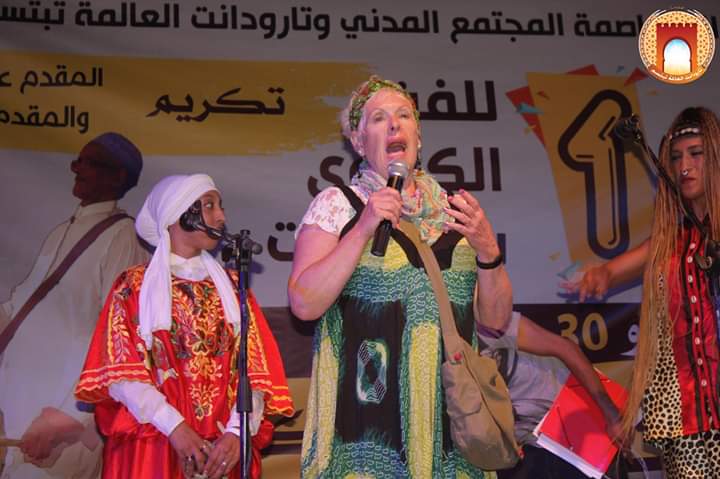
The performance is over and suddenly I'm being propelled up the steps, onto the stage and next to Titimba. Ah, they want me to hand her a Commemorative Certificate and talk a little about the festival. A microphone is thrust into my hand and I'm led to an optimum position on the stage to make my speech. But what speech? I'm on my own here and so I just open my mouth and hope that something reasonably sensible will come out.

I start with As-salamu alaykum  and the audience seem to like that. Then I apologise for speaking in English and I say what a fantastic festival it is. Then the certificate is put into my hands and I whisper to Titimba: Do you speak English? She replies: No! So, what's a girl to do? Totally instinctively I raise my fist into the air and shout GIRL POWER. It's the only way I can show how much I appreciate her performance. I hope I didn't offend anyone by that but it just seemed right at the time.


Photograph courtesy of Mohamed Elkortas


Photograph courtsey of Mohamed Elkortas

Very wisely, someone grabs the microphone off me because I could have gone on for some time and I give Titimba the certificate and we hug. And then we stand holding the certificate for the photographers to take their photographs.. I know what to do because I've seen this happen after every act. And then I'm staggering back down the steps, wondering : Did I just do that? But boy - was that fun.


Photograph courtesy of Mohamed Elkortas
 *

And now to the last act - Maalem Monsiff Bouboual  and his Gnawi and again, it's another style of Gnawa.


That smoke, by the way, is deliberate


*

The music is over but there are more Commemorative Certificates to be handed out. This time it's for the crew. So, a big shout out to the crew, without whose help no festival can take place. These back stage guys do a fantastic job and deserve merits in their own rights. I don't have names but I'm sure you'll recognise them from these final photographs.


I'm pretty sure that I have several photographs of the guy in the striped robe taken at The Essaouira Gnawa and World music Festival in 2010. He was taking part in the opening procession.


***

So, the festival is over and we've experienced a fantastic display of Gnawa Music, more than we could ever have dreamed of.  All the acts were World Class, the music so exciting, the dancing superb, the costumes absolutely gorgeous, the atmosphere electrifying and the audience appreciative

You don't need me to tell you what a wonderful tradition of Gnawa music Morocco has but I'm saying it any way. This is music grown out of  the suffering of slavery but now enjoyed by the free.

In my opinion, Gnawa  music is amongst the best in the world and the Gnawi dancers also amongst the best in the world. And there are so many excellent Gnawa groups not just in Morroco but also in other countries, for example Simo Lagnawi's Gnawa London, and many  youngsters wanting to learn and perform. And it looks as if the Taroudant Gnawa Festival will be an important showcase for Gnawa in the years to come.


Will we be coming back next year?  Yes please.

And finally, I want to thank again all those who took part in this festival and to the people of Taroudant for being such gracious hosts. May Allah bless you all.

***


Maggie and Betsey by the Ramparts of Taroudant

Maggie Knutson is a freelance journalist and has been reporting on Gnawa and also World Music for nearly twenty years. She is also an author with published newspaper articles, short stories and several novels to her name.

 Further music blog posts can be found on her blog site - maggieknutson.com

Photographs : Instagram and Flickr
Videos: You Tube

Maggie Knutson is also part of the Daftnotstupid team

And just a mention here - if you know the names of any of the Gnawi in these photographs, could you please contact me via Facebook giving details. If I get enough information, I'd like to create some sort of catalogue of Gnawi dancers. Thank you.

***

THIS POST IS DEDICATED TO MAALEM ABDESLAM KARDAN